
The future of digital metropolises
In this conversation, Jordi Castellana, Vice-President for International Affairs and Digital Metropolis at the Barcelona Metropolitan Area (AMB), reflects on the role of metropolises at a time when global challenges increasingly exceed the response capacity of traditional levels of government. Drawing on his work in decentralised cooperation, his leadership of the European Metropolitan Authorities (EMA) network, and his dual and somewhat unusual thematic portfolio combining international relations and digital policy, Castellana offers a perspective built from within a metropolitan institution that operates under real constraints and real decisions, from the very origin of action.
Question: We are living in a moment where the local and the global are in tension: increasingly polarised national governments, crises that do not respect administrative borders, and cities acting at a scale that often does not match their formal competences. What do you think can be seen from the metropolitan scale that cannot be seen from other scales of government? And why do you believe this scale is gaining relevance precisely now?
Jordi Castellana (JC): According to the UN, by 2050, 70% of the population will live in urban agglomerations. This fact has two implications: on the one hand, metropolises are where the future of society and democracy is at stake. On the other hand, the lives of the majority of citizens extend well beyond municipal boundaries, which were drawn in historical contexts with far smaller populations and a much lower degree of diversity, with the metropolitan level as the actual arena in which our lives unfold.
It should also be noted that the major challenges we face are metropolitan in scale. The metropolitan scale makes it possible to address the complexity of problems from the sphere of their real impact: the most pressing challenges of the moment, such as housing, mobility, or climate change, are metropolitan in nature. The metropolitan lens thus allows us to analyse problems in their entirety, offer solutions that deliver effective responses, and optimise resources through coordinated action among municipalities.
At the same time, these challenges are making the metropolitan scale more visible: when housing prices displace citizens to neighbouring municipalities, or when climate change affects coastal areas regardless of which municipality they fall within, it becomes clear that the metropolitan scale is relevant, and that it must be better equipped to address present-day problems.
The metropolitan lens thus allows us to analyse problems in their entirety, offer solutions that deliver effective responses, and optimise resources through coordinated action among municipalities.
Q: At the European level, investment and regulatory priorities are being reorganised around two major axes: the climate transition and the digital transition. From your dual responsibility in international relations and digital metropolis, how are you positioning the AMB within this new European framework? What opportunities and what risks do you see for metropolises in this new agenda?
JC: Indeed, European priorities are shifting rapidly, and the AMB is responding both in its organisational structure and in the actions it carries out. In the digital sphere, the reformulation of the area I lead as the International and Digital Metropolis Area pursues precisely this objective: to position the AMB in the digital debate at a European scale, and at the same time to activate local alliances in the digital field that allow us to address new priorities with greater capacity. On the climate front, the AMB has extensive experience in Climate Action, and we hope to continue leading projects that serve as references across Europe.
More broadly, I believe this new agenda represents an opportunity for metropolises: climate and digital challenges are not confined to a single municipality, but require coordinated action at the metropolitan scale. For this reason, metropolises must play a primary role in this new landscape.

Cities in motion: the metropolitan scale as the arena where today's greatest challenges unfold. Photo credits: Ryoji Iwata
Q: For decades, cities have been planned with relatively slow data: censuses, surveys, ten-year plans. Today, real-time data on mobility, consumption, use of space, and urban behaviour make it possible to use AI and digital twins for the management and planning of public services. How does this change the way a metropolis is governed? Is there a risk of only managing what is measurable?
JC: Metropolises are a living organism, and being able to take their pulse through real-time data is of great value. However, we believe that the metropolis must be shaped from a diversity of perspectives: from a long-term outlook as much as from real-time data, and above all by incorporating the qualitative perceptions of citizens, for whom we must design policies.
We therefore believe that real-time data can be of great value in adjusting service provision and in responding to unforeseen challenges or emergencies. At the same time, this real-time data can inform planning, but planning must be guided primarily by a prospective, long-term view of trends. This is the approach we are taking at the AMB through the Metropolitan Urban Master Plan, while we also receive real-time data from our various services.
Ultimately, the most important point is that management requires real-time data, but the deeper urban, social, economic, and environmental transformations that clearly define our positioning as a metropolis, on essential matters such as social, territorial, and gender equity, and with respect to all people regardless of their origin, require long-term vision and commitment. This is a commitment that the political forces of the metropolitan government hold with total clarity and conviction.
We believe that the metropolis must be shaped from a diversity of perspectives: from a long-term outlook as much as from real-time data, and above all by incorporating the qualitative perceptions of citizens, for whom we must design policies.
Q: The digital transition also has a physical dimension: data centres, networks, energy consumption, water, land. Do you think European metropolises are prepared to engage in a political debate about where and how this infrastructure is deployed? Or do we still tend to treat the digital as something "invisible"?
JC: The physical presence of the digital layer is in the midst of transformation: until recently, it did not have a significant physical impact on metropolises. However, the proliferation of data centres and related infrastructure is beginning to generate visible impacts, from land use to the need for greater energy capacity. All of this is bringing to light the need to plan how this infrastructure is implemented across the territory.
At the same time, European metropolises are starting from an unclear position in this debate: it is not evident who holds the competence to regulate data centres. Digital, land-use, energy, water, and economic development policies may fall under different institutions at the local, metropolitan, regional, and national scales, while the European level drives the deployment of digital infrastructure. For this reason, the physical dimension of the digital transition requires inter-institutional coordination, and urgently so, given that physical changes are already taking place without a defined institutional vision. In this area, we need competencies and resources that allow us to move our metropolises forward, integrating the digital revolution and the infrastructure that makes it possible in an orderly manner and with a positive impact on our residents. If we fail to do so, we will generate impacts that will widen both the physical and digital divides already present in our society.
At the AMB, we have begun this path by mapping where digital infrastructure is located to build an informed picture. We want to initiate the conversation with other administrations and infrastructure managers by bringing to the table a precise analysis and making our capacities in urban planning, water, and energy available for a coordinated response.
The physical dimension of the digital transition requires inter-institutional coordination, and urgently so, given that physical changes are already taking place without a defined institutional vision.

Data tells us how a city moves in real time, but governing it well means knowing when to look further ahead, and remembering that the digital world has a very physical footprint. Photo credits: Kit Suman
Q: Many urban digital innovations do not originate within administrations, but in complex ecosystems where technology companies, research centres, startups, universities, and local governments coexist. What role should a metropolitan institution like the AMB play in articulating these alliances? And why do you believe the metropolitan scale is particularly well suited to connecting actors who would otherwise tend to work in a fragmented way?
JC: A strong digital ecosystem will make us resilient in the face of future challenges, and the metropolitan scale is in a privileged position to bring together the relevant actors. On the one hand, many of these actors, and research centres and universities in particular, are not concentrated in a single municipality, but dispersed across metropolitan territories. On the other hand, the metropolitan scale makes it possible to anchor innovation to the needs of citizens, so that the digital ecosystem responds to real, shared challenges.
Indeed, the AMB is currently activating these alliances, facilitating collaboration among actors and seeking ways for innovation to be integrated into public policies and services.
From this perspective, it is important to note that if public institutions do not exercise their leadership to ensure a positive impact on society from the digital revolution, the private sector will exercise it, with its own interests, which are legitimate but distant from the common good and the general interest. If we want to guarantee equity and shared prosperity, we need public leadership and a commitment to dialogue and joint work with all actors in the digital ecosystem.
A strong digital ecosystem will make us resilient in the face of future challenges, and the metropolitan scale is in a privileged position to bring together the relevant actors.
Q: We always close with the same question: what do you think will be most different about living in a metropolis in 2050? And what aspect of today's metropolitan life would you most like to see confined to the past by 2050?
JC: Life in the metropolises of 2050 will undoubtedly be more efficient and sustainable: we will enjoy a higher quality of life while using fewer natural resources, with public services and mobility optimised to meet the needs of citizens. We will also have planned for long-term dynamics, such as housing and digital infrastructure, so that they are embedded in the territory in an integrated manner, generating social equity and reducing our footprint on the planet.
In this process, major challenges such as the lack of affordable housing, traffic congestion and delays in public transport will have been left behind.
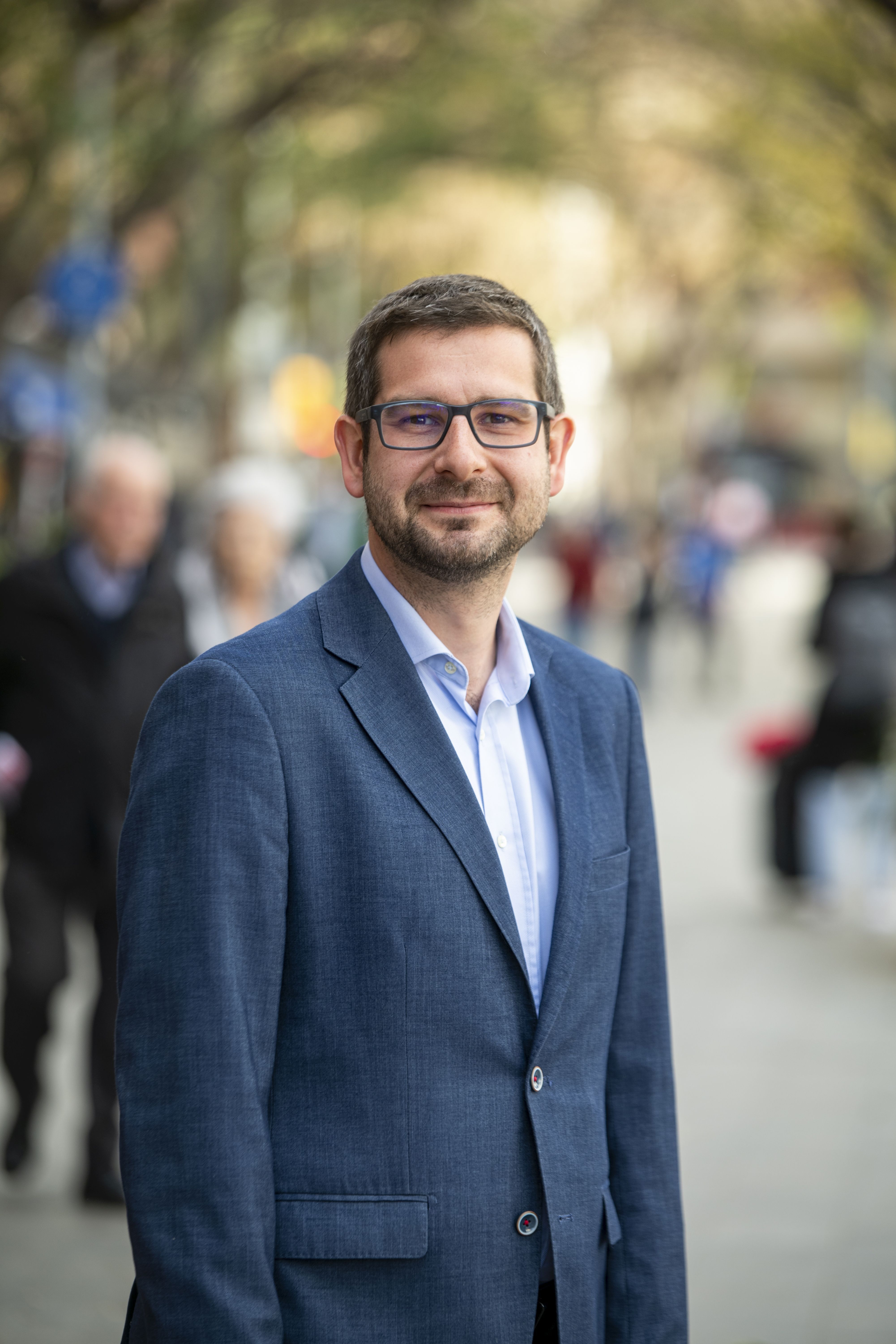
About Jordi Castellana
Jordi Castellana Gamisans has been Vice-President for International Affairs and Digital Metropolis at the Barcelona Metropolitan Area (AMB) since January 2025, and a member of the Barcelona City Council since 2019. An economist and Law graduate, he previously worked in financial auditing and in the management of non-profit organisations. He currently leads the European Metropolitan Authorities (EMA) network and is a member of the Executive Board of the Catalan Fund for Development Cooperation (Fons Català de Cooperació al Desenvolupament).
This article is based on an interview conducted by Ana Gallego, with the invaluable support of Rossella Nicoletti and Mikel Berra, editorial assistance of Isabella Magaña. The text has been edited for readability purposes.